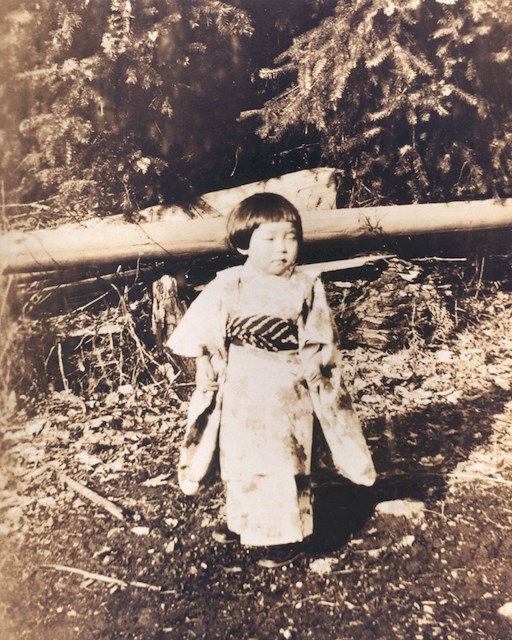
NEX̱WLÉLEX̱WM (BOWEN ISLAND): HISTORICAL CONTEXT
Nex̱wlélex̱wm (Bowen Island) is within the traditional territory of the Squamish Nation (Sḵwx̱wú7mesh Úxwumixw). For countless generations, Squamish people have lived on, travelled through, harvested from, and cared for the island. Archaeological evidence and early records describe cedar plank houses, smokehouses, seasonal camps, and important fishing sites, including in what is now Snug Cove. The island formed part of a much larger cultural landscape connected by family, trade, travel, and stewardship throughout Átl’ḵa7tsem (Howe Sound).
European settlement on Bowen Island began in the early 1870s through British Columbia's pre-emption system. Under this colonial policy, settlers could claim parcels of Crown land, occupy and “improve” them for a prescribed period, and eventually purchase the land at a nominal price.
The system was based on European concepts of private land ownership and agricultural improvement. It disregarded Indigenous systems of land tenure, occupation, and stewardship and formed part of the broader colonial process through which Indigenous lands were transferred into settler ownership.
Indigenous people were excluded from pre-empting Crown land for decades, and their longstanding occupation, use, and stewardship of these lands were not recognized under colonial law.
Understanding this history provides important context for the experiences of Japanese Canadians. Although their histories and circumstances were distinct, Indigenous Peoples and Japanese Canadians both experienced dispossession through government policies shaped by colonialism and racism. These policies operated in different ways and had different consequences, but each reflected broader systems that determined who could own land, where people could live, and whose rights were recognized.
While this website focuses on the history of Japanese Canadians on Bowen Island, their experiences form part of a broader history of racial exclusion in British Columbia that also affected Indigenous Peoples and other racialized communities, including Chinese, South Asian, Black, and Filipino Canadians.
By placing these histories in context, we hope to deepen understanding of the systems that shaped British Columbia and contribute to the ongoing work of historical truth, redress, and reconciliation.
Japanese History Of Bowen Island
The first Japanese person we encounter in Bowen Island's history has no name.
The earliest known reference to a Japanese person on Bowen Island dates to about 1888–1890. It appears in a memoir written by Norah Walton, the daughter of Joseph Mannion, who owned property at what is now Mannion Bay and later became Mayor of Vancouver. Recalling her childhood on the island, she described the family's many animals and briefly mentioned the Japanese gardener employed by her father:
"The most curious pet we had was a crow; he had in some way or other sustained a crushed claw and as it was infected and festered the Japanese gardener we had at the time amputated it at the joint and we always suspected that he slit its tongue as 'Blacky' could always talk as fluently as a parrot and where he learned to swear was always a mystery."
This brief passage offers a fascinating glimpse into everyday life on early Bowen Island, but it also reveals the limitations of the historical record. The gardener's name was never recorded, and nothing more is currently known about his life. Like many early Japanese immigrants to British Columbia, he appears only fleetingly in the surviving written record.
Over the following decades, the archival record slowly became richer. Census returns, immigration records, tax rolls, newspaper accounts, photographs, family collections, and oral histories allow us to identify some of the men, women, and children who lived and worked on Bowen Island. Yet even these records are often incomplete. Names may be misspelled or omitted altogether, occupations recorded without personal details, and the voices of Japanese Canadians largely absent from official documents.
One of the goals of this project is to help restore those stories. By bringing together archival records, photographs, family histories, and oral testimony, we can begin to reconnect names with faces, families with places, and individuals with the community they helped build.
While many stories remain incomplete, each new discovery adds another piece to the history of Japanese Canadians on Bowen Island and helps ensure that lives once overlooked are remembered.
Life, Work & community on Bowen Island
By the early twentieth century, Japanese immigrants and Canadians of Japanese descent were part of the working and community life of Bowen Island. They worked in logging, fishing, mining, agriculture, manufacturing, and the growing resort economy, contributing to industries that connected the island to communities throughout Átl’ḵa7tsem / Howe Sound.
Their experiences were varied. Some came to Bowen for seasonal or industrial work; others remained for years, raising families and becoming part of island life while working in farming, gardening, and the resort economy. Their lives were also shaped by the racial attitudes and discriminatory policies of the period, which affected where they could work, live, and participate in society.
The stories that follow explore both the industries in which Japanese people worked and the individuals and families whose lives became connected to Bowen Island.
Explore the stories of the Yamada family, Daikichi Koga, and Eikichi Kagetsu, or discover Japanese Canadian connections to logging, mining, fishing, and the Tunstall Bay explosives plant.
Loggers on Bowen island
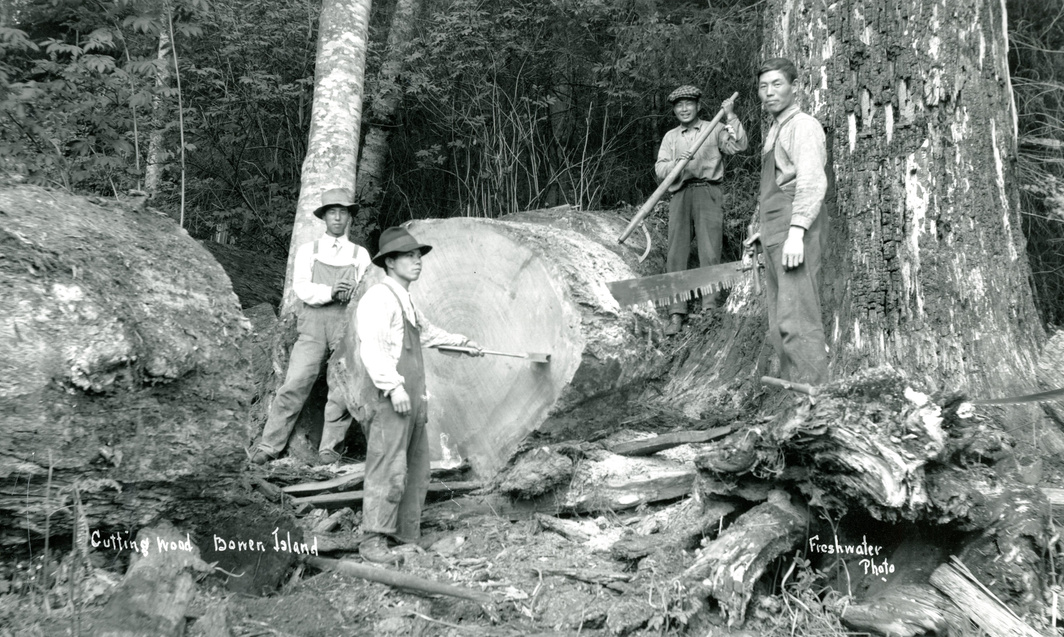
Logging was one of the earliest industries to attract Japanese immigrants to Bowen Island. Drawn by employment opportunities in British Columbia's rapidly expanding forest industry, Japanese workers became an important part of the island's logging camps during the late nineteenth and early twentieth centuries.
The earliest documented evidence of Japanese loggers on Bowen Island comes from 1899, when Edward Galbraith hired Japanese shingle-bolt workers to help clear his land. It is likely that Japanese loggers had been working on the island before this date, but no earlier documentation has yet been found.
By 1902, Japanese workers were well established in the local logging industry. The Report of the Chief Commissioner of Lands and Works noted that Bowen Island contained "several shingle-bolt camps, that mostly employ Japanese," providing one of the earliest official acknowledgements of their significant role in the island's economy.
Shingle bolts were straight, knot-free sections of cedar or Douglas-fir cut specifically for producing hand-split shingles used to roof and clad buildings throughout British Columbia. The abundance of western red cedar on Bowen Island made shingle production an important local industry, and Japanese workers became highly regarded for their skill and productivity.
The 1901 Census of Canada provides the first surviving names of Japanese people living on Bowen Island. It records thirteen Japanese loggers working in two separate camps, offering the earliest documented glimpse of a community that would continue to grow over the following decades. Although the census preserves their names, it tells us little about their lives beyond their occupations, reminding us once again how much of their history remains to be discovered.
The First Recorded Japanese Loggers on Bowen Island (1901 Census)
| Employer / Camp | Name (as recorded in the 1901 Census) | Occupation | Notes |
| J. Horne's Camp | Yasacoke | Logger | Census spelling |
| Mursaki | Logger | Census spelling | |
| Takane | Logger | Census spelling | |
| Nemoreo | Logger | Census spelling | |
| Sennsi | Logger | Census spelling | |
| Maitura | Logger | Census spelling | |
| Yoshimora | Logger | Census spelling | |
| Me Yo Sake | Bookkeeper? / Logger | Occupation should be verified from census | |
| Second Logging Camp | Tomaika (22) | Logger | Age recorded in census |
| Shitka Take (26) | Logger | Age recorded in census | |
| Tadakuma (27) | Logger | Age recorded in census | |
| Yamanto (30) | Logger | Age recorded in census | |
| Okamitu (35) | Logger | Age recorded in census |
Note: Names are reproduced as they were recorded in the 1901 Census. Spellings may reflect transcription errors or the census enumerator's interpretation of spoken Japanese names.
The Challenge of Names
Early census records often misspelled or anglicized Japanese names because enumerators wrote what they heard. As a result, some names are difficult to identify today. Ongoing research may allow us to match these entries with their correct Japanese names and family histories.
Fishing
The waters surrounding Bowen Island have long supported abundant marine life and sustained Indigenous communities for thousands of years. Each summer, vast salmon runs travelled through the Strait of Georgia and Átl’ḵa7tsem (Howe Sound), drawing seals, sea lions, porpoises, and orcas into the area. These same salmon runs later attracted commercial fishermen, including many Japanese immigrants who became highly skilled participants in British Columbia's growing fishing industry.
Although documentary evidence is limited, Japanese fishermen were likely working in the waters around Bowen Island by the late 1880s and 1890s. During the fishing season, crews travelled along the coast following the salmon runs, sometimes camping on islands before returning with their catches to canneries and markets. With its sheltered bays and proximity to major fishing grounds, Bowen Island was one of many places where fishermen could stop during the season.
"The most beautiful sight in those days was the Japanese fishing fleet. Many of them used to spend the daytime in various bays and my brothers and I used to beg to go out with our favorite boat. Those nights on the water were magical as each boat had a coloured lamp on its float nets and it looked like a fairy haul in the salmon. I can still smell the mixture of fish and petrol fumes though."
-Lennie Crookston

Conflict on the coast
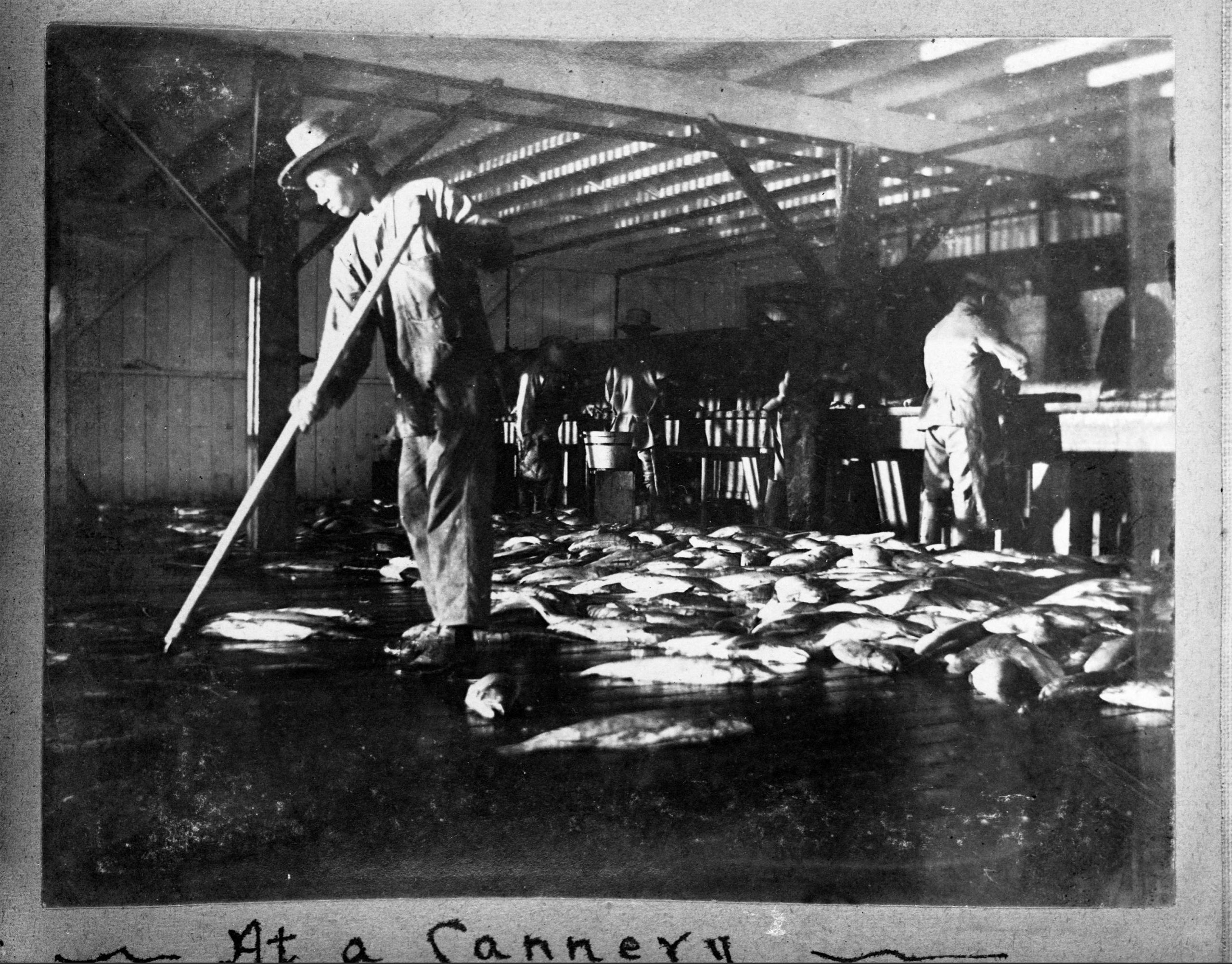
By the late nineteenth century, commercial fishing had become one of British Columbia's most important industries, but it was also one of its most contested. Cannery owners controlled the prices paid for fish, while fishermen increasingly organized to improve wages and working conditions.
The industry was also deeply divided by race. White, Japanese, and Indigenous fishermen often worked alongside one another but belonged to separate organizations and faced different legal and social restrictions. Japanese fishermen, despite their growing importance to the industry, were frequently subjected to discrimination and repeated attempts to exclude them from fishing altogether.
In 1893, after Japanese fishermen were refused membership in the Fraser River Fishermen's Protective and Benevolent Association, they formed their own organization, the Fraser River Fishermen's Association, commonly known as the Dantai. Indigenous fishing communities continued to organize through their own traditional leadership and community structures. Although there were occasional efforts to cooperate, competition for fishing licences, employment, and access to the resource, combined with widespread racial prejudice, often divided the three groups.
In 1900 and again in 1901, disputes over fish prices led to major strikes. While fishermen sought better prices from the canneries, racial tensions increasingly overshadowed labour issues. Some white union leaders openly argued that Japanese fishermen should be driven from the industry, creating an atmosphere that quickly escalated into violence.
the “Kidnapping” of 1901
One of the most dramatic episodes occurred on 10 July 1901 and brought Bowen Island unexpectedly into the centre of the conflict.
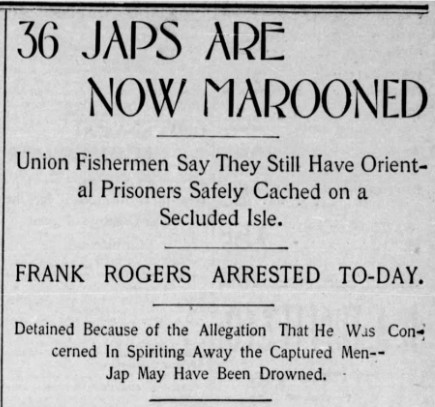
During the strike, nine Japanese fishermen working near Point Grey were confronted by a group of white fishermen. According to court testimony, the Japanese fishermen were forced at gunpoint into a single boat and towed across the water to Seymour Bay on Bowen Island. There, shortly after one o'clock in the morning, they were abandoned without oars, a sail, or the equipment needed to return safely to Vancouver.
The stranded fishermen eventually found Alexander Seymour, who provided them with oars and assistance. With additional help from steamship operator Hugh Stalker, they were able to return to Vancouver the following day, where they reported the incident to police. Charges of kidnapping and unlawful confinement were laid against Frank Rogers and Samuel Desplain, both prominent members of the white fishermen's union.
The trial attracted widespread public attention. Despite the testimony of the Japanese fishermen, both defendants were acquitted by an all-white jury. Contemporary newspaper accounts describe crowds gathering outside the courthouse following the verdict, reflecting the strong anti-Japanese sentiment that existed in British Columbia at the time.
Although little evidence survives of the seasonal fishing camps themselves, the Seymour Bay incident demonstrates that Bowen Island was not isolated from the racial tensions shaping British Columbia's fishing industry. The events of July 1901 remain one of the clearest local examples of the discrimination and violence experienced by Japanese fishermen during this period.
Mining
Mineral exploration on Bowen Island began in the 1880s, focused primarily on copper and slate, with smaller deposits of gold and silver.
One of the better-known operations was the Albion Mine, located south of Cates Bay near present-day Eagle Cliff. During the 1890s, the mine produced primarily copper ore with small quantities of gold, although activity later declined.
Interest in the area revived briefly in November 1907. After mine owner John J. Moore staked a new claim, ten Japanese prospectors staked mineral claims near Hood Point and Deep Cove on November 13, 1907. All ten claims were recorded two days later, on November 15.
Together, these ten claims accounted for 10 of the 22 mineral claims recorded on Bowen Island in 1907, providing striking evidence of Japanese participation in yet another of the island's resource industries.
The fact that all ten claims were staked on the same day and recorded two days later suggests that the prospectors' activities may have been connected. However, the surviving records do not establish whether they were working together or simply pursuing claims in the same area.
Two of the names have intriguing connections to the wider history of Canadians of Japanese descent. Tadao Nakamura, who staked the Nadeshiki claim, may be the same man who appears in later records connected with the Malkin family on Bowen Island, although this has not yet been confirmed. Mohei Satow, holder of the Botan claim, later became a trustee of the Vancouver Japanese Language School.
Although the Albion Mining Company ceased operations in 1909 because the deposits proved uneconomic, these claims reveal another little-known chapter in Bowen Island's history. Ten of the island's 22 mineral claims in 1907 were staked by Japanese prospectors, evidence that Japanese immigrants were participating in a much wider range of economic activity than the surviving historical narrative has often suggested.
Japanese Mineral Claims Registered on Bowen Island, November 1907
| Claim Name | Recorded Owner |
| Momide | Shiski Zenko |
| Gold Flower | Sawada Yasuguki |
| Sunrise | Okuji Rokumatsu |
| Take | Kodama Matsuji |
| Botan | Satow Mohei |
| Matsu | Ejaki Tomitaro |
| Fuji | Akubo Veke |
| Hakushan | Nagai Tokujo |
| Kanatsuka | Okuji K. |
| Nadeshiki | Nakamura Tadao |
All claims were staked on 13 November 1907 and recorded on 15 November 1907.
Tunstall Bay
A story often told on Bowen Island is that an explosives factory once stood at Tunstall Bay and disappeared in a massive explosion. The story is only partly true.
In 1909, Western Explosives Limited purchased approximately 600 acres at Tunstall Bay and established an explosives manufacturing plant. Much of the surrounding land had already been logged and was largely depleted of forest, while the site was well separated from the more populated area around Snug Cove. In 1909, Western Explosives Limited purchased approximately 600 acres at Tunstall Bay and established an explosives manufacturing plant. The location was well suited to explosives production: much of the surrounding land had already been logged and was largely depleted of forest, and the site was isolated from the more populated area around Snug Cove.
Construction proceeded quickly. The factory complex included bunkhouses for the approximately 80 Japanese, Chinese, and white men employed at the site. Worker accommodation was segregated by race. Production began in May 1909.
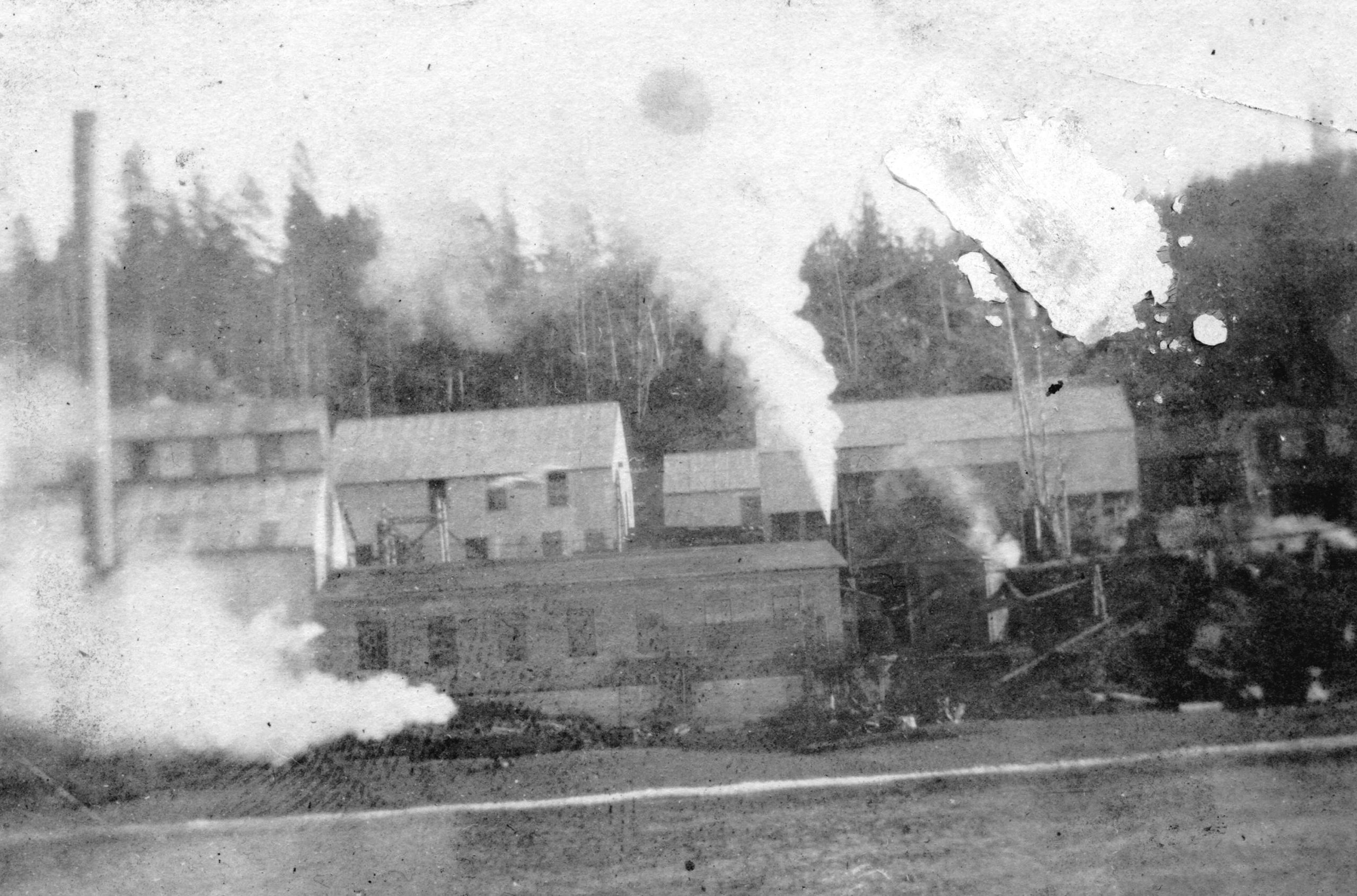
Within months, the first fatal accident occurred.
On August 16, 1909, an explosion in the dynamite packing house killed five men: William Seller, an American, and four Chinese workers, Low Fook, Jong Young, Ah Yurn, and Quang Jung.
Four months later, on December 16, another explosion occurred, this time in the black powder magazine. An unidentified Chinese worker was seriously injured, and Asakichi Yamazaki, a 24-year-old Japanese worker, was killed.
On March 2, 1910, T. O'Brian suffered severe burns after lighting a match to smoke his pipe. Black powder embedded in his clothing ignited, and he later died from his injuries in hospital.
Just ten days later, another explosion tore through the dynamite packing house. The blast was reportedly powerful enough to be felt in Nanaimo, across the Strait of Georgia. Six men were killed: James Burton, an American, and five Chinese workers, Lin Ho, Don Chong, Lee Wing Yuen, Fong Bow, and Kong Hee.
Safety and Language
The inquest that followed the March explosion raised serious questions about safety practices at the plant, particularly how safety information was communicated to workers.
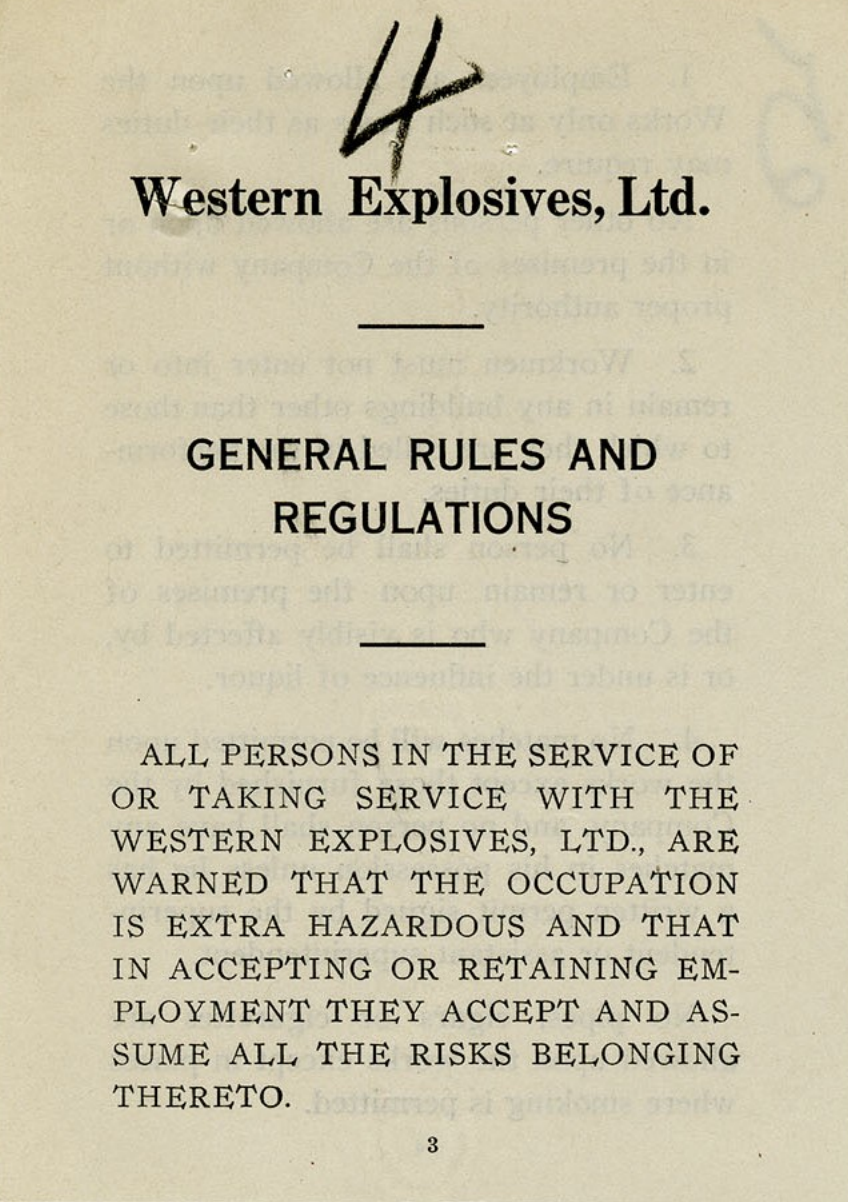
A company representative maintained that standard precautions were in place: workers were prohibited from carrying matches; smoking was restricted to designated areas; iron-nailed boots were prohibited; and workers were provided with a safety manual.
The inquest revealed, however, that the manual was printed only in English, a language many of the workers could not read.
Western Explosives stated that a copy had been given to Lin Ho, who interpreted its contents for the other workers. Wong Pang, another Chinese worker, disputed this account. He testified that the Chinese workers understood that they were not to carry matches or smoke, but that the safety rules themselves had not been read or explained to them.
The jury subsequently recommended that the safety manual be translated.
What Happened to the Factory?
Western Explosives was sold to Canadian Explosives Limited in 1911. Contrary to the familiar Bowen Island story, the Tunstall Bay factory did not disappear in one enormous explosion. The remaining buildings and bunkhouses were eventually dismantled and transported by scow to James Island in Haro Strait, where explosives manufacturing continued.
The story of Tunstall Bay is therefore more complex than the local legend suggests.
The accidents at the plant killed at least thirteen workers, most of them Chinese or Japanese. The records also reveal a racially segregated workplace where critical safety information was available only in English, despite a multilingual workforce.
The Tunstall Bay plant provides a rare glimpse into the experiences of Chinese and Japanese workers in an especially dangerous industry and forms part of the broader history of racialized labour in early twentieth-century British Columbia.
Steamship company
A foundational element of Bowen Island’s history were the steamship companies that sailed up and down the B.C. coast, passengers and goods in tow.
In the 1880’s and 90’s, the island was largely made up of small family homesteads that conducted their business, mostly agricultural, in Vancouver. In 1902, the Cate brothers established the Terminal Steamship company in Snug Cove and Deep Bay, The ships would transport holidaymakers from Vancouver to the island where they would spend their time enjoying the scenery and leisure of the company’s hotel, cottages and campsites.
Nikkei would have been employed for Terminal Steamships from its beginning, from logging to clear land, to building the hotel, and likely even the steamships themselves. According to census records most of the Nikkei employed by the company were classified simply as “Labourers”, but would have worked on numerous facets of the company’s operations. This largely would have included building and maintaining the hotels’ grounds and attractions such as the Japanese bridge adorning Bridal Falls, gardens, farms, and hydroelectric projects. Many Nikkei lived on site at the company cottages, sometimes with their families as well.
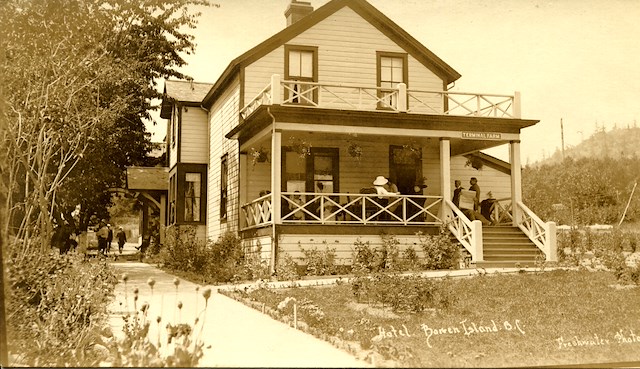
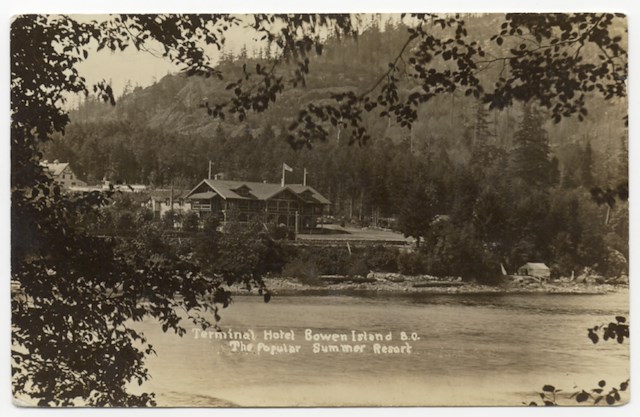
In 1922, the Terminal Steamship Company was purchased by the Union Steamship Company. This new company expanded their reach outside of tourism to industry and the transportation of goods to industrial hubs along the B.C. coast such as Woodfibre, Britannia Mine, and Ocean Falls. On Bowen, tourism continued to thrive in great part due to the Nikkei living on Bowen who used their skill and dedication to contribute to Bowen’s idyllic scenery.
One such person was Mr. Shimizu, who worked as a gardener for the Union Steamship Company, tending primarily to the resort’s vegetable gardens. He lived on Bowen Island with his wife, whose name has not yet been identified, and their children. Two of their children, Kamio and Kiamasa Shimizu, are recorded as attending Bowen Island School between approximately 1923 and 1925.
In 1924/25 a storm battered the island and destroyed the bridge connecting the Union Steamships Hotel grounds to Snug Cove. The causeway was thus built in its place, likely by Japanese Canadians working at the hotel. The original causeway was constructed of wood and lit with electric lights, laying the groundwork for its contemporary equivalent which stands in the same place today.
Another record of Japanese life on Bowen Island is that of Harry Mochizuki, who operated the market gardens that supplied the Union Steamships resort. He and his wife, Hisa, lived at Seymour Bay on the southeast side of the island. Their daughter, Sayako, was born in 1926 and attended school on Bowen Island in 1932–33.
The 1931 census records six boarders living in the Mochizuki household. All were of Japanese descent or citizenship and were recorded as labourers working in the market garden
Sakugoro Fukuyama, age 49, immigrated in 1919
Siguro Kawabsta, age 32, immigrated in 1925
Jenicki Kitamura, age 21, born in British Columbia
Maida, (?), age 25, immigrated in 1927
Matsuzo, Sawamura, age 55, immigrated in 1907 and became a naturalized citizen in 1914
Chojiso, Rimura, age 52, immigrated in 1907
Note: Names are reproduced as they were recorded in the 1901 Census. Spellings may reflect transcription errors or the census enumerator's interpretation of spoken Japanese names.