

Fishermen Marooned
During the 1901 Fraser River fishing strike, nine Japanese fishermen working near Point Grey were seized and taken by boat to Bowen Island. According to later court testimony, they were left at Seymour Bay during the night without oars, sail or equipment. Bowen resident Alexander Seymour assisted the men, who returned to Vancouver and reported…
Read MoreStill Barred from the Coast
By 1944, the war was nearing its end, but Canadians of Japanese descent were still not allowed to return to the B.C. coast. Instead, the federal government encouraged families to move east of the Rockies and began planning for the removal of others to Japan. For families who had already lost their homes and communities,…
Read MoreVancouver Anti-Asian Riot
On September 7, 1907, an anti-Asian demonstration in Vancouver developed into violence as a crowd moved through Chinatown and then into the Japanese neighbourhood around Powell Street, damaging businesses and homes. Japanese residents defended their community. The riot reflected the intense anti-Asian racism and exclusion that Japanese immigrants encountered in British Columbia. Learn more
Read MoreMove East or Go to Japan
In 1945, Canadians of Japanese descent were told they could not return to their homes on the B.C. coast. Instead, they were expected to move east of the Rockies or sign papers indicating they would go to Japan. For families already uprooted and dispossessed, returning to the communities they had known before the war was…
Read MoreJapanese Mining Claims
In November 1907, ten Japanese men staked mineral claims on Bowen Island, reflecting Japanese participation in another of the industries developing around Átl’ḵa7tsem / Howe Sound. Provincial mining records show considerable prospecting on Bowen that year, with 22 mineral claims recorded on the island. Source: B.C. Minister of Mines, Annual Report, 1907, p. L158. Learn…
Read MoreOpposition to Deportation
As the federal government pursued plans to deport Canadians of Japanese descent to Japan, opposition grew across Canada. Students and professors at the University of Saskatchewan protested the policy. Professor S. Mack Eastman argued that stripping Canadians of their nationality and deporting them because of their ancestry violated the principles of the new United Nations…
Read MoreJapanese Immigration Restricted
In 1908, Canadian Minister of Labour Rodolphe Lemieux negotiated an agreement with Japanese Foreign Minister Tadasu Hayashi to restrict immigration from Japan. Under the Hayashi-Lemieux Agreement, Japan limited passports for male labourers and domestic servants to 400 annually. Returning residents and certain family members were exempt, contributing to the growth of Japanese Canadian families and…
Read MoreDeported to Japan
Between May and December 1946, 3,964 Canadians of Japanese descent were sent to Japan. Many had been born in Canada and had never lived in Japan. Families left from communities and incarceration sites across the country, several years after they had first been forced from their homes on the B.C. coast. Photo: Japanese Canadians being…
Read MoreImmigration Restrictions Expand
Canada’s Immigration Act of 1910 expanded the federal government’s power to restrict immigration and deport people it considered inadmissible. That year, an Order-in-Council imposed an additional financial barrier on immigrants of “Asiatic origin,” requiring them to possess $200 on arrival, compared with $25 required of other immigrants. These measures added to the restrictions already limiting…
Read MoreDeportation Orders Repealed
In January 1947, the federal government repealed the orders that provided for the deportation of Canadians of Japanese descent. Nearly 4,000 people had already been sent to Japan. Those who remained in Canada were still restricted from returning to the B.C. coast, and many families were now rebuilding their lives elsewhere in the country. Learn…
Read MoreJapanese Canadians Enlist
Japanese Canadian men who volunteered for military service faced barriers to enlistment in British Columbia. In 1916, many travelled to Alberta, where they were accepted into Canadian Expeditionary Force units. Between 1916 and 1918, 222 Japanese Canadian soldiers served on the Western Front. Their wartime service later became central to veterans’ efforts to secure the…
Read MoreFree to Return to the Coast
On April 1, 1949, the restrictions that had kept Canadians of Japanese descent from returning to the B.C. coast were finally gone. Seven years after the forced removal, people were free to return to communities they had once called home. But homes and property had been sold, families had been dispersed, and relatively few returned.…
Read MoreBorn on Bowen
Mits Sumiya was born on Bowen Island on November 22, 1922, into a Japanese Canadian logging family. He later attended the University of British Columbia, hoping to pursue engineering and nuclear physics. In 1942, his studies were interrupted by the forced removal of Canadians of Japanese descent from the coast. Sumiya resisted removal and was…
Read MoreProperty Compensation
After years of protest over the forced sale of their property, Canadians of Japanese descent brought claims before the Bird Commission. Its final report was completed in 1950 and recommended compensation where property had been sold below fair market value. The process provided some financial compensation, but did not return the homes, businesses and possessions…
Read MoreRacism Discussed on Bowen
In June 1931, about forty students gathered on Bowen Island to study inter-racial relations around the Pacific. Rev. K. Shimizu of Vancouver spoke about the experiences of second-generation Japanese Canadians, including discrimination and questions of belonging. The meeting shows that racial prejudice and the place of Japanese Canadians in Canadian society were being openly debated…
Read MoreVeterans Gain the Vote
After returning from the First World War, Japanese Canadian veterans campaigned for the right to vote, drawing on their wartime service in their appeals for political equality. In 1931, British Columbia extended the provincial franchise to Japanese Canadian First World War veterans. They also gained the federal franchise, although other Canadians of Japanese descent remained…
Read MoreGakuyūkai Picnic on Bowen
Members of the Gakuyūkai gathered on Bowen Island for their annual picnic on June 21, 1931. The large group photograph captures young Canadians of Japanese descent enjoying Bowen as a place for recreation and community gatherings. It is part of a broader history of Japanese Canadian families and organizations visiting the island for picnics, outings…
Read MoreCommunity Life at Woodfibre
Japanese Canadians were an established part of the community at Woodfibre in Átl’ḵa7tsem / Howe Sound. Men worked at the pulp mill and other industries, while families built lives around the settlement. Photographs from the 1930s record community gatherings, sports and recreation, showing Woodfibre as a place where people lived as well as worked. Learn…
Read MoreA Regular Route Across the Pacific
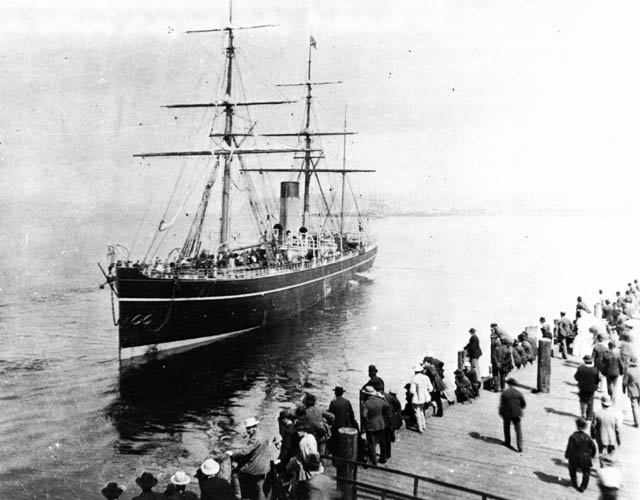
In 1887, regular steamship service began between Yokohama and Vancouver, making travel between Japan and British Columbia more accessible. The new connection contributed to increasing migration from Japan. Many early immigrants came seeking work and economic opportunities in British Columbia’s growing industries. Photo: SS Abyssinia arriving at Vancouver, June 14, 1887 Learn more
Read MoreGrowing Up on Bowen
The Yamada children grew up at King Edward Bay, where their parents, Kanichi and Masano Yamada, established a home and dairy farm. The children attended Bowen Island School and formed friendships with other island children. Their experiences show that Canadians of Japanese descent were not simply workers on Bowen—they were families and members of the…
Read More