From the moment the first Japanese people arrived in Canada, they faced discrimination at the hands of both the government and everyday people. Incarceration did not start with Pearl Harbour or World War II; its roots can be found decades earlier in the rhetoric of the “Yellow Peril” and the “Japanese Question.” Forced removal and incarceration were the culmination of decades of racism directed towards the Japanese community in B.C. Wartime security was used to justify these actions, despite the lack of evidence that the Japanese Canadian community posed a security threat.(1)
The forced removal and incarceration of Nikkei from B.C. was not simply a response to wartime events. Powerful people like Ian Mackenzie, one of the main architects of removal and incarceration, were calling for the complete removal of Japanese people from B.C. because of their race. For those seeking to create a “white B.C.,” forced removal and incarceration became a means of achieving that goal. While there were moderating forces within the government, they were not particularly effective during the early stages of removal and incarceration. (1)
how did we get here?
In the 1930s, global tensions were growing. Japan and Canada had been allies in the 1920s, but this relationship changed when Japan invaded Manchuria in 1931, expanded its war in China in 1937, and finally entered into a formal alliance with Germany and Italy in 1940. As tensions increased, the government planned for the possibility of war, and the question of a Japanese attack on Canada arose. In 1940, after investigations, the Department of National Defence reassured the government that a full-scale attack on Canada by Japan was extremely unlikely. (1) Despite this reassurance, some members of government continued to see people of Japanese descent as a security threat. The possibility of incarcerating Japanese Canadians was already being contemplated as early as 1938, before Canada was at war with either Germany or Japan. (1)
By 1940, the RCMP was monitoring the Japanese Canadian community. Its investigations found no evidence to suggest that the community posed a security risk. RCMP Assistant Commissioner Frederick J. Mead reported, “No fear of sabotage need be expected from the Japanese in Canada.” (1) Senior military officials reached the same conclusion. Major-General Ken Stuart stated, “From the army point of view, I cannot see that Japanese Canadians constitute the slightest menace to national security.” (1) Despite these assessments, members of the B.C. government continued to push for the removal of people of Japanese descent from the coast.
How did the restrictions escalate?
In 1939, Canada declared war on Germany. The War Measures Act came into effect, giving the federal government sweeping powers to impose wartime restrictions.
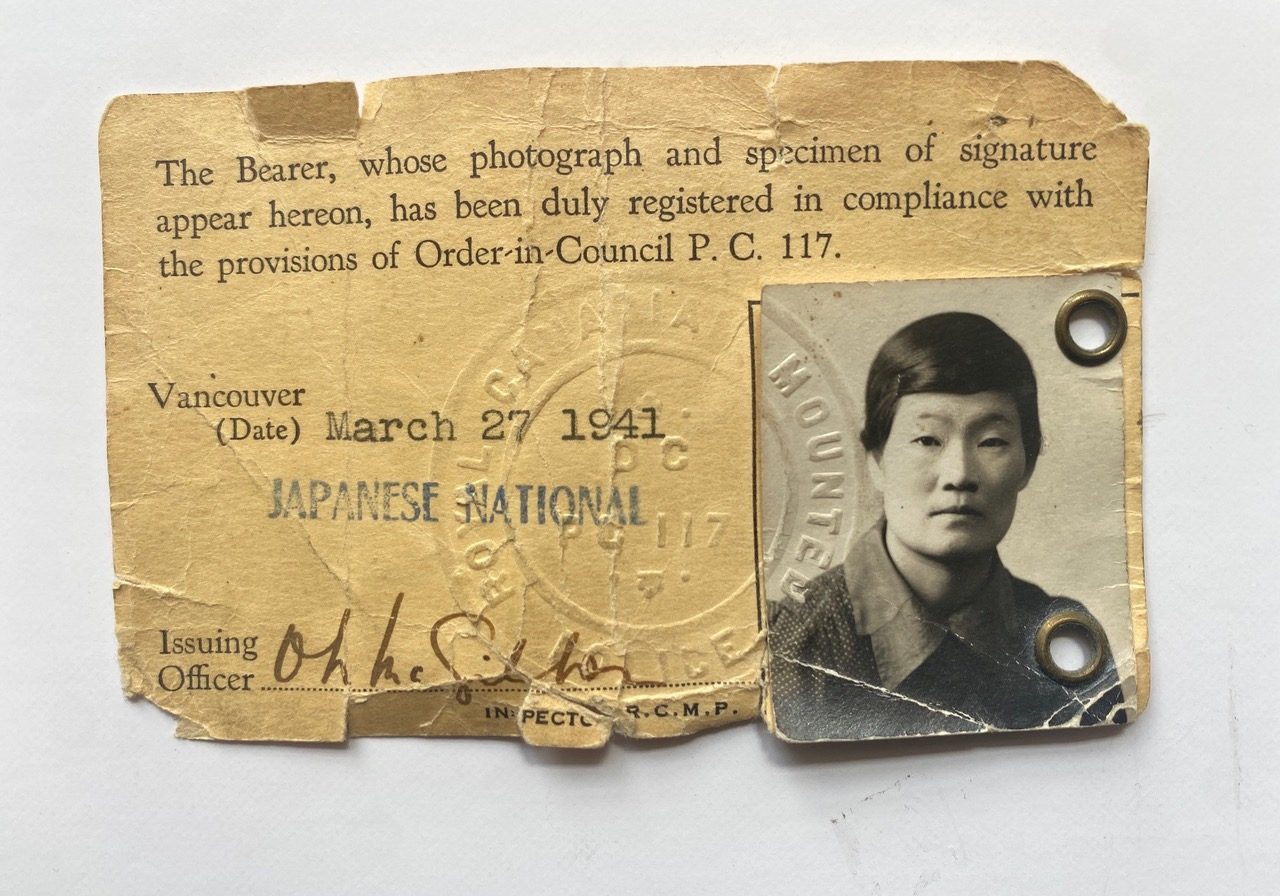
In 1941, months before Canada was at war with Japan, the federal government required all people of Japanese descent to register with the RCMP. They were issued identification cards with registration numbers and were required to carry them, giving the government detailed information about the Japanese Canadian population as further restrictions were imposed. (2)
What changed after Pearl Harbor?
Canada declared war on Japan on December 8, 1941, one day after Japan attacked the American naval base at Pearl Harbor. This strengthened the resolve of politicians and citizens who were already calling for the removal of Nikkei from B.C. On that same day, the Royal Canadian Navy began impounding some 1,200 fishing vessels operated by Japanese Canadians, signalling what was to come. (1)
In the days following Canada's declaration of war, Japanese nationals were ordered to re-register with the RCMP as enemy aliens. Japanese-language schools and newspapers were closed, and further restrictions were imposed on Japanese Canadians. These measures were not taking place without public support. Many people in B.C. were openly calling for the removal of Japanese Canadians, and some wrote to the government demanding that it remove “as many Japanese as possible.” (5)
How were Japanese Canadians forced from their homes?
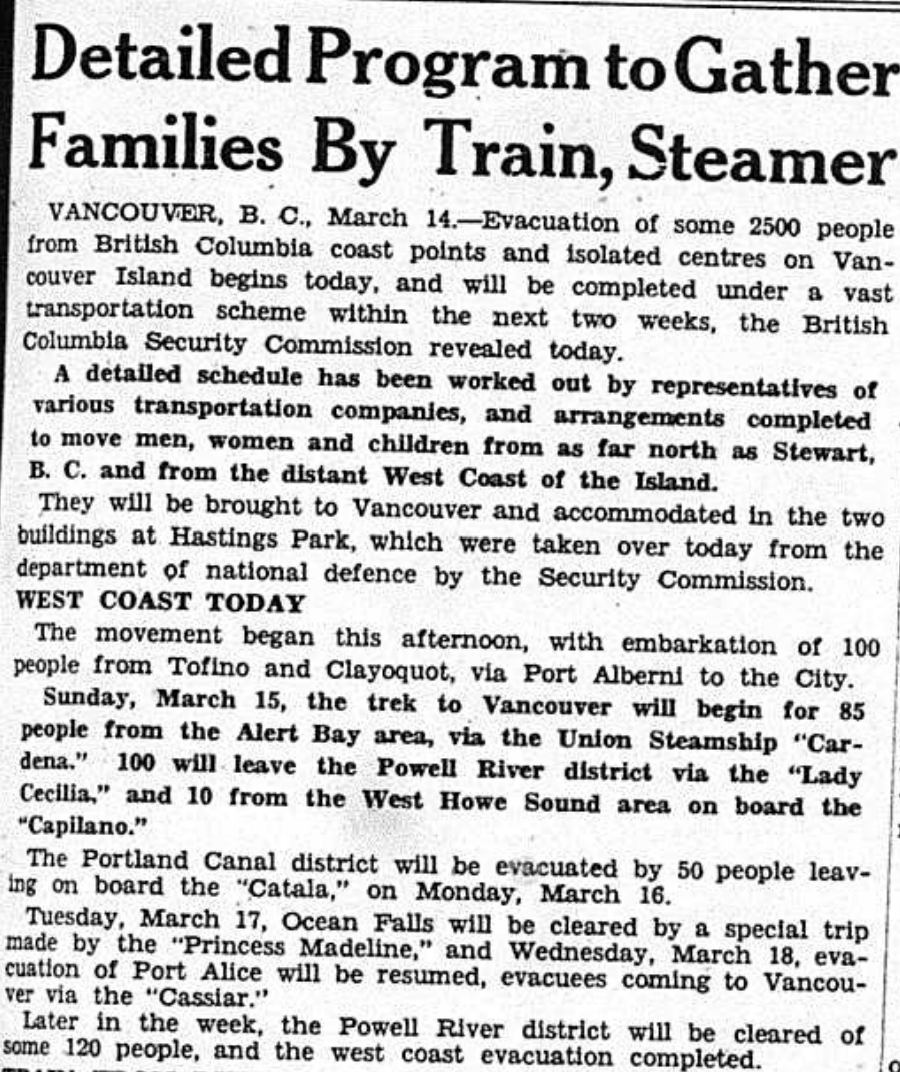
The government created what they called the “protected area,” or what is referred to today as the restricted area, as shortly after, Japanese people no longer had freedom of movement. This zone extended 100 miles from the B.C. coast into the interior, where the vast majority of Japanese Canadians lived, to remove as many as possible (1). In the spring of 1942, all Japanese people had to vacate the restricted area. Some 22,000 people would be forced to leave their homes (3).
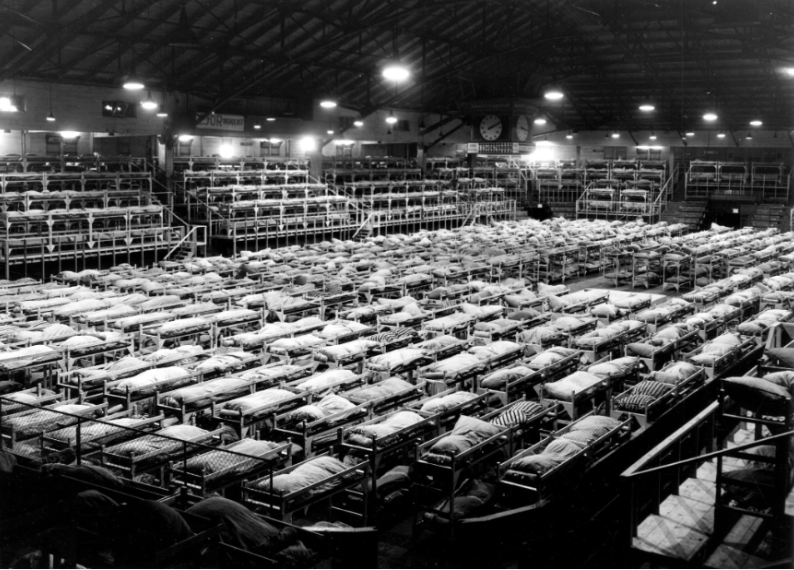
The first to leave were able-bodied men aged 18-45 who were sent to forced labour camps to build parts of the highway and the incarceration sites. Everyone else soon followed. They could bring only what they could carry: a maximum of 1 or 2 suitcases totalling 150 lb per adult and 75 lb for a child (1). Those not living in the Vancouver area were sent to the Hastings Park holding center. The site was transformed from the Pacific National Exhibition (PNE) into a place through which some 8,000 people would pass (4). For many, this was the traumatic start to incarceration.
Families were separated on arrival, with women, girls and boys under the age of 13 housed in a livestock building, while the men and boys over 13 lived in a converted ice rink and roller arena (6). Conditions were horrific. There was no privacy, and the site was unsanitary, with some remembering maggots crawling on floors. (6)
On March 25th, the B.C security commission started sending people to internment or incarceration sites (6). Families were separated, with men sent to forced labour camps and women and children sent to ghost towns or purpose-built incarceration sites. Some families instead chose to enter agricultural contracts in the prairies to remain together.
By the fall of 1942, there were 12,000 people incarcerated in the interior; the rest of the 22,000 ‘voluntarily’ left to the east of the Rockies (1). Anyone who protested any part of incarceration was sent to a prisoner of war camp in Ontario (1).
What was incarceration like?
There were 10 main sites of incarceration across the interior of B.C.; some were converted ghost towns from the gold rush, others were purpose-built, but in the end they were all the same, simply a prison by another name.
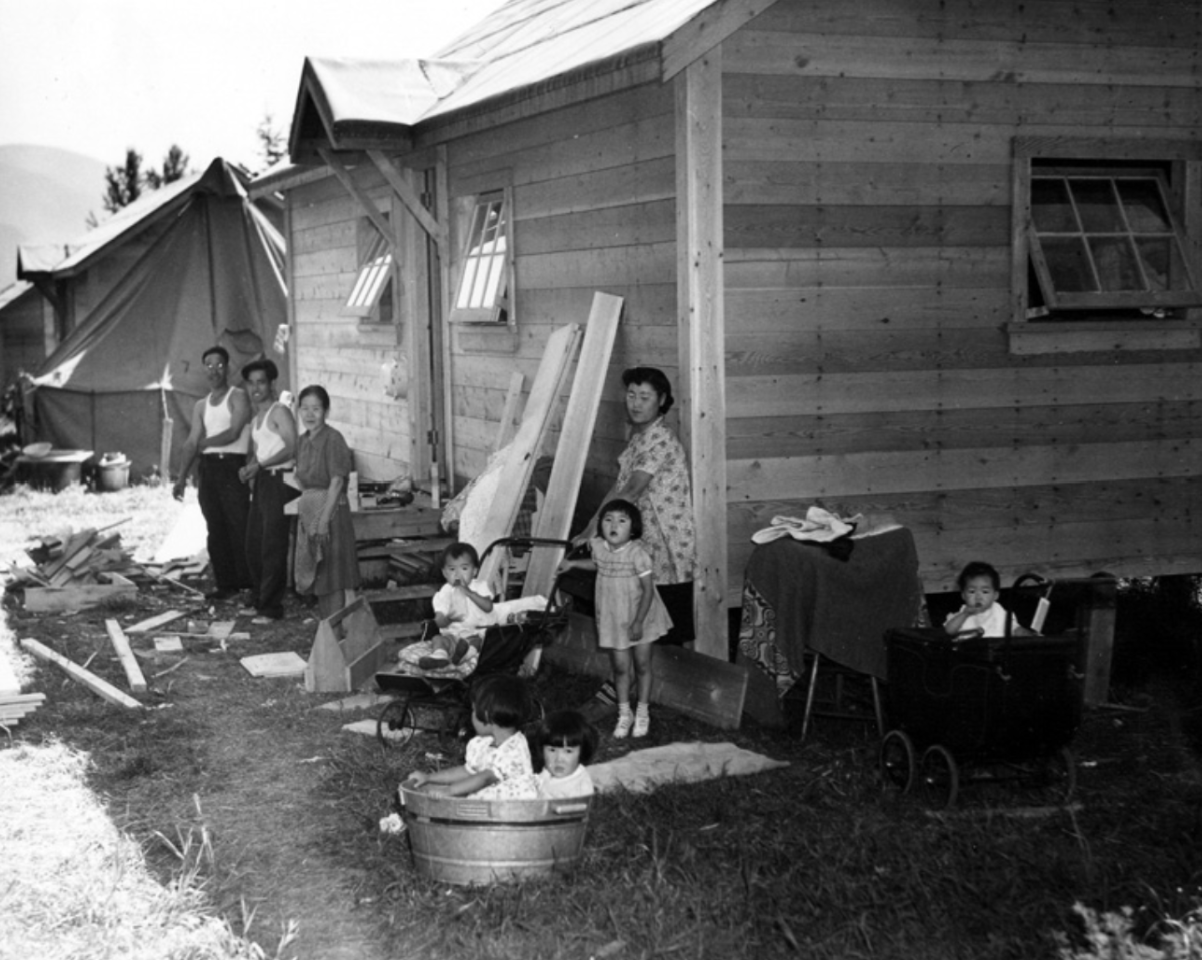
Nikkei forced labour built shacks quickly and cheaply. They were small, made of green wood, and lacked insulation, paper, and tar for weatherproofing. It was not uncommon for two or more families to share the two-room spaces, often without running water.
As the weather got colder, the wood shrank, creating massive gaps for the snow and cold to get through, so people had to stuff newspapers in between, with only a small woodstove in the kitchen to stay warm. Outhouses were shared by multiple families and sometimes far away from living sites. They lacked access to medical assistance and education. (8)
Despite the conditions, people did what they could to survive, creating community events, gardens, temples and churches all to create a sense of normalcy that was so desperately needed.
Where did the money come from to build all this?
Japanese Canadians were made to bear many of the costs of their own incarceration. From transportation to food, expenses associated with their forced displacement were charged to the same people the government had removed from their homes. Men sent to forced labour camps had deductions taken from what little pay they received to help support their incarcerated families. (9)
In January 1943, the federal government authorized the Custodian of Enemy Property to sell property belonging to Japanese Canadians without their consent. Homes, businesses, vehicles and other possessions were sold, often for far less than their owners believed they were worth. The proceeds were not simply returned to the owners. The government controlled the funds, releasing money to families for living expenses and using their own assets to help cover costs associated with their forced displacement and incarceration. (9)
The war is about to end, what now?
By 1944, the government was planning to permanently disperse Japanese Canadians from British Columbia. People were pressured to choose between so-called “repatriation” to Japan at a future date or immediate resettlement east of the Rockies. For many Canadian-born people, “repatriation” was a misleading term: Canada was their home, and some had never been to Japan. (1)
The entire system, according to historian Ann Gomer Sunahara, was “calculated to induce the bitter and confused inmates of the detention camps in B.C. to choose Japan.” (1) Those who chose Japan were told they could remain in B.C. until free transportation was arranged. They would receive relief funding, and those without property in Japan would receive $200 per adult and $50 per child. (1)
In contrast, those who chose to remain in Canada and resettle east of the Rockies would receive only $60 per couple and $12 per child to establish themselves. They were expected to have “definite employment,” which might last only a few weeks, with no guarantee of housing. For many, this reinforced concerns they already had, as letters from those living east of the Rockies described the difficulties they faced finding employment and housing. (1)
By August 1945, 10,347 people had signed to go to Japan. (1) Japan formally surrendered on September 2, 1945, ending the Second World War. The surrender changed the circumstances under which many people had made their decision. Some had believed that the war would continue and that Japan might eventually prevail. Reports of the difficult conditions in postwar Japan also gave people reason to reconsider. In total, 4,527 people sought to withdraw their requests for “repatriation.” (1)
What followed was a lengthy legal and political battle over the government's deportation policy. The federal government was more divided on the issue than the B.C. provincial government, and opposition to deportation grew. Japanese Canadians and their supporters organized against the policy, while civil liberties groups, churches and others brought the issue to public attention. Growing public opposition made it increasingly difficult for the government to proceed with the mass deportation of people who no longer wished to leave Canada.
In the end, 3,964 people were sent to Japan in 1946, many of them Canadian-born. (1) Although they had signed for “repatriation,” describing their departure simply as a free choice ignores the circumstances in which that decision was made. They had already experienced years of forced removal, incarceration, dispossession and uncertainty about whether they would ever be allowed to return to the B.C. coast. For many, the choice to go to Japan was made when the alternatives available to them in Canada seemed very limited.
What happened to those who stayed in Canada?
An important aspect of this period is that Multiculturalism was not yet part of Canadian public policy. The historian Ann Gomer Sunahara writes that the prevailing philosophy was that for a state to be stable and governable, the people had to be culturally homogeneous, and due to the white supremacists' belief that meant conforming to Anglo-Canadian culture (1).
This was the opinion across party lines as the only difference was that “racists believed non-white minorities could never assimilate, while liberals believed they could and should,” (1). This was even the opinion held by the Canadian association of the Japanese which in their 1923 constitution stated that their mission was “To effect the progress and advancement of Japanese residents in Canada and assimilate them” (10).
The other side of this philosophy was that ‘racial tensions’ or racism was believed to be caused when someone expressed a culture other than Anglo-Canadian; in plain language, it was to blame the victim. So in order for the government to assimilate the Nikkei and avoid ‘racial tensions,’ they used regulatory powers to distribute and restrict Nikkei from living in clusters.
Housing remained an issue because of the influx of people, the difficulty of finding someone willing to rent to Japanese people, and the fact that there were no other Japanese people in the area (1). This only made resettlement harder for Nikkei.
For those who stayed in Canada, life was extremely difficult. A small number were able to remain in B.C., outside the restricted zone, because they were deemed unemployable or were veterans or sick. For most people east of the Rockies, housing was a major issue.
Hostels were built in major cities and likely sites of employment for the ‘resettlers,’ but they were created to discourage long-term stays, having poor conditions not much better than the shacks at incarceration sites.
Most Nikkei worked on farms, in factories, in logging, in mining, and in domestic work (1). Even with the hardships of starting over, Nikkei began to rebuild their lives.
Another dark chapter in Canada's history
The legal restrictions imposed on Japanese Canadians did not end with the war. By December 1946, most of the incarceration sites were empty, although approximately 900 people remained in the Slocan area, many of them elderly, ill, or members of their families. (1) In 1947, there were 6,776 Nikkei in B.C., less than one-third of the pre-war population. Some 13,000 Nikkei had been dispersed across Canada, where the government hoped they would assimilate. (1)
Restrictions on the movement of Japanese Canadians remained in place after the war, preventing them from freely returning to the B.C. coast and making it extremely difficult to re-establish the communities that had existed there before 1942. These restrictions were finally lifted on April 1, 1949.
The incarceration of Nikkei in Canada is part of a dark history that everyone living in this country should know and reckon with. The forced removal and incarceration of some 22,000 people was neither necessary nor humane. It was government-sanctioned racism carried out under the justification of wartime security.
Sources:
1) Sunahara, Ann Gomer. The politics of racism : the uprooting of Japanese Canadians during the Second World War, (James Lorimer & company), 1981.
2) The National Association of the Japanese, “Japanese Canadian History” https://najc.ca/japanese-canadian-history/
3) Japanese Canadian History, "Reference timeline” https://japanesecanadianhistory.net/historical-overview/reference-timeline/
4) Nikkei national museum and cultural center, “Japanese Canadian Timeline” https://centre.nikkeiplace.org/research/japanese-canadian-timeline/
5) landscapes of injustice, Letters and Resolutions Re Japanese Canadians nnm_2018-16-3-3.pdf
6) Hastings Park 1942 https://hastingspark1942.ca/
7) Tashme Historical Project, “Tashme Monogatari: Glimpses of Life in a Relocation,” Victor Kadonaga. http://tashme.ca/stories/tashme-stories-victor-kadonaga/
8) Nikkei internment memorial center, “A longer history” https://www.nikkeicentre.ca/our-history
9) Landscapes of injustice, “case 2.3 paying for internment” https://loi.uvic.ca/narrative/cases/case-2.3.html
10) Tadashi Jack Kagetsu, the Tree Trunk Can Be My Pillow: The Biography of an Outstanding Japanese Canadian, (University of Victoria), 2017.