In 1949, the last restrictions imposed on Canadians of Japanese descent during the wartime era were lifted. But the damage caused by years of forced removal, incarceration, dispossession and forced dispersal could not simply be undone. Families had been uprooted, homes and property lost, and communities scattered across Canada and Japan. Some communities were rebuilt; others never were. (1)
Rebuilding
Rebuilding lives after 1949 was difficult. Many families were starting again with limited financial resources, often far from the communities they had known before the war, while continuing to encounter discrimination in housing, employment and everyday life. The communities that had once existed along the B.C. coast could not simply be recreated.
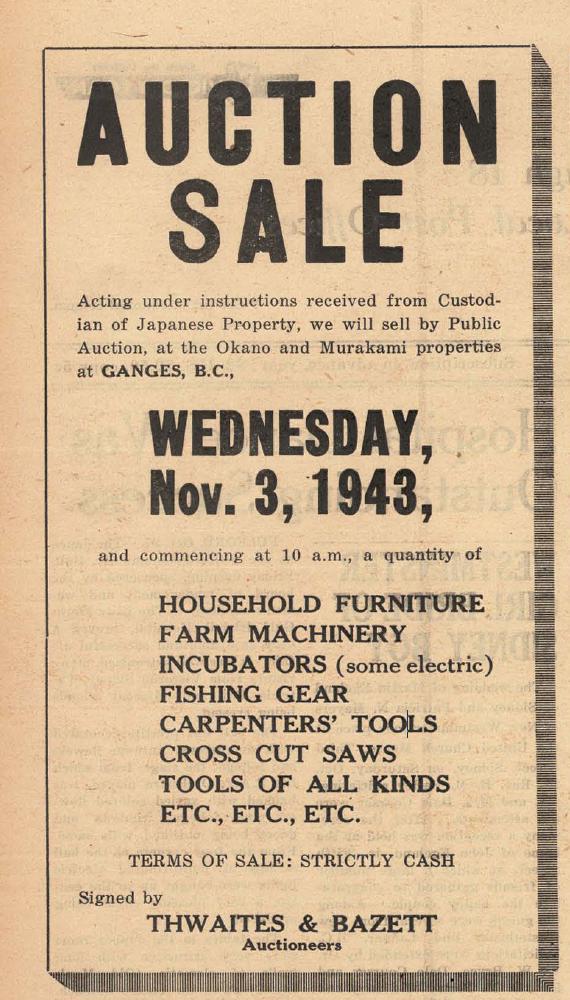
There had been some hope for financial restitution when the federal government established the Bird Commission in 1947 to investigate claims arising from the forced sale of Japanese Canadian property. But its mandate was narrow. The Commission did not consider the full range of losses caused by dispossession, nor did it compensate people for everything that had been taken from them.
Historian Kaitlin Findlay notes that the Commission’s narrow terms of reference excluded many losses from consideration and prevented some people who had lost property from submitting claims at all. The Commission ultimately recommended $1,222,829 in awards, with a further $150,000 later paid in special awards. Even these payments addressed only a portion of the losses Japanese Canadians had suffered. (6)
RETURNING TO THE COAST
On March 31, 1949, the last restrictions on the movement of Japanese Canadians were lifted. From April 1, they were once again free to live anywhere in Canada, including the B.C. coast. They had regained the federal right to vote in 1948, and British Columbia restored their right to vote provincially in 1949. (1, 7)
But relatively few returned to the coast. Many had established new lives elsewhere and, after the forced sale of their homes, businesses and property, lacked the financial resources to start over yet again. For others, returning meant going back to places associated with forced removal and profound loss.
Seiji Homma, a former Vancouver resident who had settled in Greenwood, questioned why he should return: “Why should we risk our futures again by going back?” He later reflected, “We never talk about it any more. We were very bitter at the time but what’s the use of reviving all that now.”
So few Japanese Canadians initially returned that Vancouver newspapers struggled to find returnees to interview. Gradually, however, a Japanese Canadian community began to re-establish itself in Vancouver. By 1952, approximately 2,000 Japanese Canadians were living in Greater Vancouver — still only a fraction of the pre-war population. (2)
REBUILDING COMMUNITY
Japanese Canadian communities continued to rebuild through the 1950s and 1960s. Changes to Canada’s immigration policies also brought new arrivals from Japan. In 1967, Canada introduced a points-based immigration system that assessed prospective immigrants according to standardized criteria rather than the racial and national-origin preferences that had shaped earlier immigration policy. This contributed to a new period of immigration from Japan. (1, 3)
By the Japanese Canadian Centennial in 1977, much had changed. Toronto had become an important centre of Japanese Canadian life alongside Vancouver, while postwar immigrants from Japan contributed to communities that were increasingly diverse in their experiences and connections to Japan.
The Centennial, marking 100 years since the arrival of Manzo Nagano in Canada, also encouraged renewed interest in Japanese Canadian history and identity. Celebrations, exhibitions, publications and community activities created opportunities to examine both the achievements of Japanese Canadians and the injustices they had experienced. This growing engagement with the past helped create the conditions for the redress movement that followed. (1, 3, 7)
Activism
ACTIVISM AND THE REDRESS MOVEMENT
The National Japanese Canadian Citizens’ Association (NJCCA) was formed in 1947 to advocate for the welfare and civil rights of Japanese Canadians. By the late 1970s, a growing movement was calling on the federal government to formally acknowledge the injustices of the 1940s and provide redress. In 1980, the NJCCA became the National Association of Japanese Canadians (NAJC). (7)
Redress developed into a national grassroots campaign. Japanese Canadians organized meetings, gathered evidence, documented family experiences and built public support. The movement brought together community leaders, activists and individuals whose families had experienced forced removal, incarceration, dispossession and dispersal. (7, 8)
An important part of the campaign was establishing the scale of the economic losses. In 1986, a study by Price Waterhouse estimated the economic losses resulting from wartime property confiscation at $443 million in 1986 dollars. The calculation addressed material losses; it could not account for the loss of civil rights, community, opportunity or the broader effects on individuals and families. (8)
Redress was also about preventing such abuses from happening again. The NAJC called for stronger protections for civil liberties and changes to the War Measures Act, under whose authority many wartime measures against Japanese Canadians had been implemented through Orders-in-Council and other regulations. In 1988, the War Measures Act was repealed and replaced by the Emergencies Act, which introduced greater parliamentary oversight and protections for rights under the Canadian Charter of Rights and Freedoms. (8)
Redress
After a decade-long fight for justice, on September 22, 1988, Prime Minister Brian Mulroney formally acknowledged and apologized for the injustices committed against Japanese Canadians by the federal government. The Redress Agreement ultimately provided approximately $300 million in compensation and other redress measures, including individual payments of $21,000 to eligible survivors, $12 million for the Japanese Canadian community, and funding toward the creation of the Canadian Race Relations Foundation.
Redress did not end in 1988. In 2022, after years of advocacy by the Japanese Canadian community, the B.C. government committed $100 million to address the historical wrongs committed against Japanese Canadians by the province. The funding supports six legacy pillars: education, heritage, seniors’ health and wellness, community and culture, monument, and anti-racism. The Japanese Canadian Legacies Society (JCLS) was created to oversee this work, helping to ensure that redress extends beyond acknowledgement and apology to education, remembrance and lasting change.
CULTURAL AND COMMUNITY LEGACY
The consequences of forced removal, incarceration and dispossession extended far beyond the loss of homes, businesses and livelihoods. The federal government’s postwar policy deliberately dispersed Japanese Canadians across Canada and encouraged assimilation, disrupting established communities and profoundly changing the circumstances in which Japanese Canadian culture, language and community life could continue. (1, 3)
With prewar communities dismantled and families scattered across the country, many Japanese Canadians rebuilt their lives in places where there were few others of Japanese descent. The effects of assimilation were particularly evident in some postwar communities. Historian Darren Aoki’s research with Nisei in southern Alberta, for example, examines individuals who described themselves as having become almost completely assimilated, structurally and culturally, into the Canadian mainstream. (5)
The demographic effects of this history can also be seen in later generations. In the 2006 Census, 74.7% of couples involving at least one Japanese person included a non-Japanese partner, the highest proportion among the visible-minority groups examined by Statistics Canada. (9) The long history of Japanese settlement in Canada and the relatively small size of the Japanese Canadian population have been identified as factors associated with this high rate. Professor Audrey Kobayashi has also connected the exceptionally high level of intermarriage among Japanese Canadians to the destruction of Japanese Canadian social infrastructure during the 1940s. (4)
The effects of dispersal were also felt in the loss or weakening of Japanese-language use, cultural traditions, community networks and connections between generations. At the same time, Japanese Canadians created new organizations, cultural centres and community networks across Canada. These became important places for preserving culture, recovering histories and building new forms of Japanese Canadian identity and community. (3, 5)
REMEMBERING AND RECOVERING THE PAST
For many Japanese Canadians who experienced forced removal and incarceration, the events of the 1940s were not openly discussed in the years that followed. Some chose not to speak about what had happened, while others passed their memories on to children and grandchildren. Over time, descendants, community organizations, researchers and historians have worked to document these experiences and ensure that they are not forgotten. (3, 5)
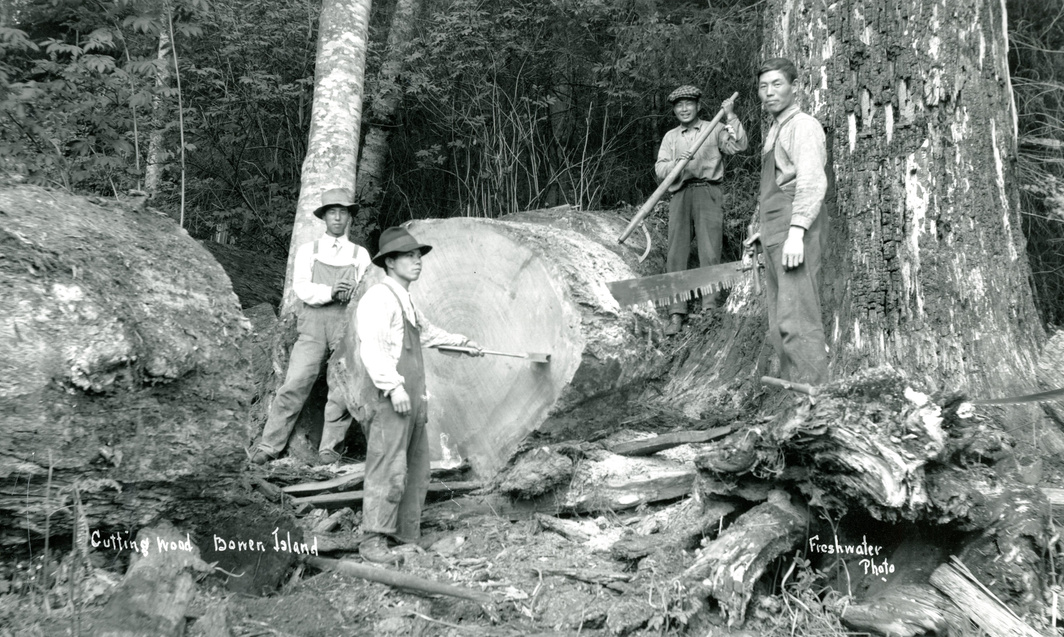
Today there is considerable scholarship on the forced removal, incarceration and dispossession of Japanese Canadians. Much less, however, has been written about the Canadians of Japanese descent who lived and worked on Bowen Island and throughout Átl’ḵa7tsem / Howe Sound, or about the families and communities they created here.
Research for this website has drawn heavily on primary sources to recover these local histories: photographs, newspapers, government records, archival documents, oral histories and family collections. Together, they reveal a history that is both part of the wider Japanese Canadian experience in Canada and distinctly rooted in the communities and landscape of this region.
NEX̱WLÉLEX̱WM KYOSEI (共生) PEACE PARK
The Nex̱wlélex̱wm Kyosei (共生) Peace Park grew from a desire to give the Japanese Canadian history of Bowen Island and Átl’ḵa7tsem / Howe Sound a permanent place of remembrance on Bowen Island.
Developed by the Bowen Island Museum & Archives with support from the Japanese Canadian Legacies Society (JCLS), the project forms part of the continuing legacy work arising from B.C. Redress. (11) It brings together archival research, family histories, photographs and oral histories to remember the Canadians of Japanese descent who lived, worked and spent time here, as well as the forced removal, incarceration and dispossession that disrupted those lives and communities. JCLS describes its place-based heritage projects as part of the legacy initiatives created through the B.C. Redress process.
The park is located at Sandy Beach Municipal Park overlooking Mannion Bay, a place closely connected to Bowen Island’s early resort history and to the work of Daikichi Koga and other Japanese workers. Interpretive panels and this website extend beyond the park itself, connecting Bowen Island to Japanese Canadian communities, workplaces and industries throughout Howe Sound.
The name Kyosei (共生) broadly expresses the idea of living together or coexistence. The park is intended not only as a place to remember what happened, but as a place to consider what that history asks of us today.
NEX̱WLÉLEX̱WM
Nex̱wlélex̱wm is the Sḵwx̱wú7mesh name for Bowen Island. Its use in the name of the Peace Park acknowledges that the park is located within the traditional territory of the Sḵwx̱wú7mesh Úxwumixw (Squamish Nation).
Including Nex̱wlélex̱wm in the park’s name also places the Japanese Canadian history remembered here within the longer history of this land and recognizes that the places now known as Bowen Island and Howe Sound have Indigenous names, histories and connections that continue today.
Sources:
- Japanese Canadian History “Reference timeline,” https://japanesecanadianhistory.net/historical-overview/reference-timeline/
- Roy, Patricia E. "The Re-creation of Vancouver’s Japanese Community, 1945–2008". Journal of the Canadian Historical Association / Revue de la Société historique du Canada 19, no. 2 (2008) : 127–154. https://doi.org/10.7202/037751ar
- Japanese Canadian Cultural Center, “Online Exhibition Japanese Canadian: A Story of Hope, Resilience and Growth” https://jccc.on.ca/heritage/exhibitions/japanese-canadian
- The bulletin, “Mixed Marriages: Why Are There So Many Among Japanese Canadians?” Masaki Watanabe, 2010 https://jccabulletin-geppo.ca/mixed-marriages-why-are-there-so-many-among-japanese-canadians/
- Aoki Darren J. “Assimilation—On (Not) Turning White: Memory and the Narration of the Postwar History of Japanese Canadians in Southern Alberta” Journal of Canadian Studies/Revue d'études canadiennes, Volume 53, no.2 (2019).
- Kaitlin Findlay, "Bird Commission in Context," Landscapes of Injustice, April 16, 2021, https://www.landscapesofinjustice.com/project-activity/bird-commission-in-context-kaitlin-findlay/.
- National Association of Japanese Canadians, “Our History”, https://najc.ca/history/
- Japanese Canadian History, “Afterword: Redress”, Ann Gomer Sunahara, https://japanesecanadianhistory.ca/afterword-redress/.