Eikichi Kagetsu’s life encompassed both the opportunities and the profound injustices experienced by Canadians of Japanese descent in British Columbia.
Much of what we know about his life was recorded by his son, Tadashi Jack Kagetsu, in the biography The Tree Trunk Can Be My Pillow.
Eikichi Kagetsu was born on September 5, 1883, the youngest of ten children, in what is now Wakayama Prefecture, Japan. In 1906, he came to Canada after hearing of opportunities in the lumber industry.
He initially worked at Britannia Mine and for the Still Creek Logging Company, saving enough money to establish his own logging ventures.
Challenging Racial Restrictions
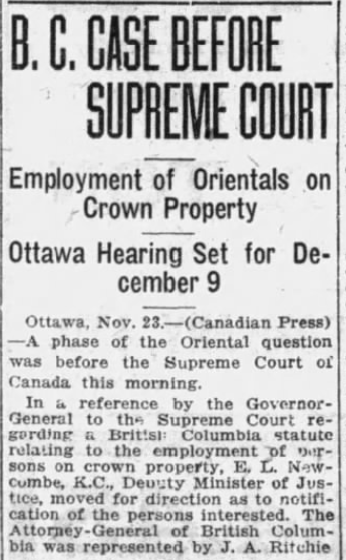
In 1917, Kagetsu purchased timberland near Loughborough Inlet at a place known as Roy. As his logging interests grew, his business encountered provincial restrictions on Japanese participation in the forestry industry. A prohibition on the employment of Japanese workers on Crown timber threatened his operations.
The Canadian Japanese Association (CJA), working with Japanese forestry workers and other organizations with interests in the industry, challenged the restriction. The CJA retained Sir Charles Tupper as counsel, and the dispute eventually reached the Judicial Committee of the Privy Council in Britain, then Canada’s highest court of appeal.
In 1922, the Supreme Court of Canada ruled against the provincial restriction. The British Columbia government appealed the decision to the Privy Council.
On October 18, 1922, the Privy Council upheld the Supreme Court decision, finding that the restriction on employing Japanese workers was incompatible with Canada’s treaty obligations with Japan. The decision allowed Kagetsu and other Japanese Canadian logging operators to continue employing Japanese workers on their operations.
During the legal battle, Kagetsu became increasingly involved in the Canadian Japanese Association and was elected a councillor in 1921. He would later serve several terms as president of the organization while continuing to expand his logging interests.
Logging at Seymour Bay
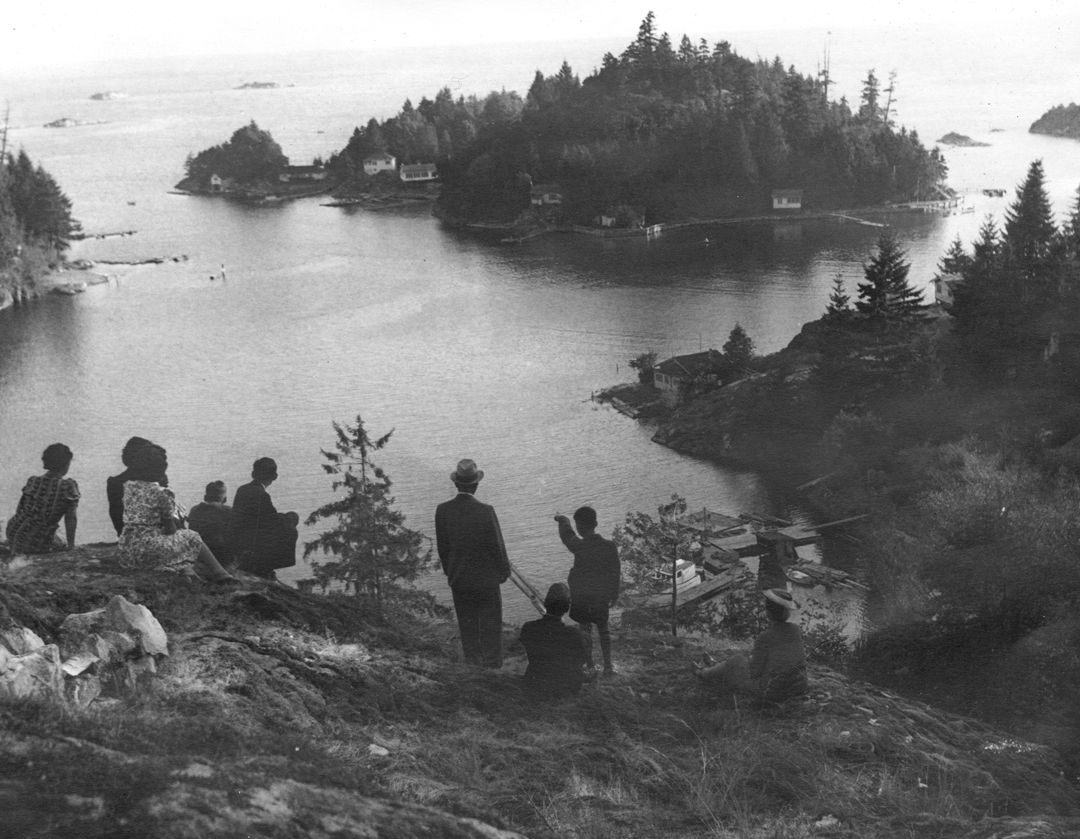
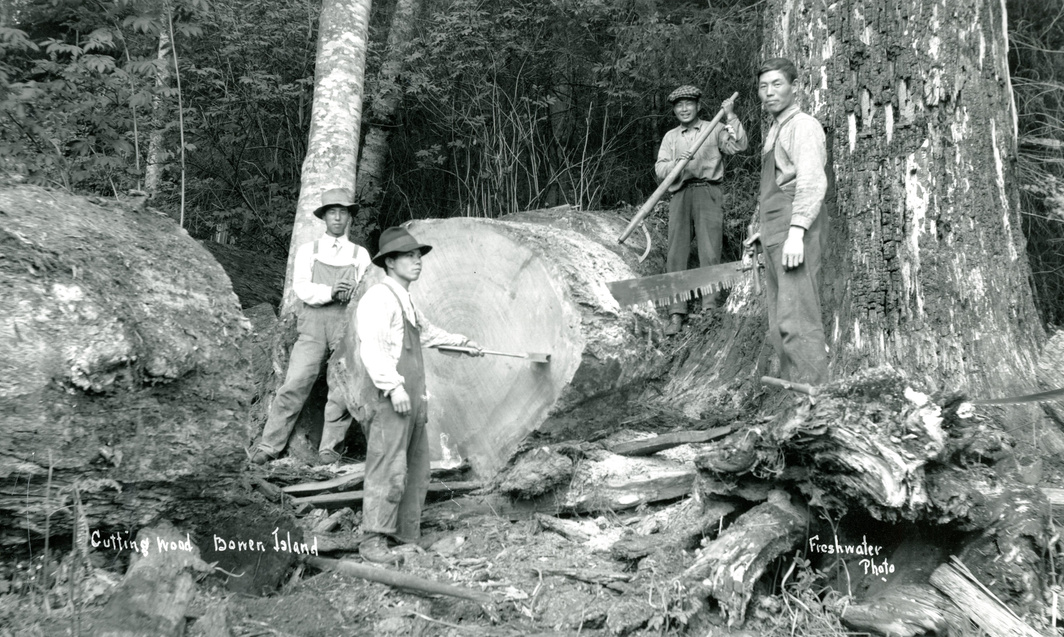
In 1922, Kagetsu established a logging operation on Lot 2448, approximately 320 acres in the Seymour Bay area of Bowen Island. The precise nature of his tenure on the land has not yet been confirmed.
Logging camps housed workers and their families, creating a small community around the operation.
Bowen Island resident Marjorie Woods later recalled the log booms and slides as an irresistible playground for local children:
“The log booms and log slides were a constant source of joy to us children, though not, I imagine, to our mothers … we would slide and run along the booms like monkeys until we got ducked by smaller logs.”
Her recollections also provide a rare glimpse of the social connections that developed between Japanese families and other residents:
“We used to take an old wind-up gramophone to the Island and this was a great fascination to the little Japanese women who would come, babies on their backs, walking through the woods for a social call on my mother. They always brought some of their own grown vegetables and lettuce — the likes of which I have never tasted since.”
Alongside the industrial activity at Seymour Bay, Woods’ memories describe families, children, gardens and neighbours, offering a glimpse of everyday life around the logging operation.
Businessman and Community Leader
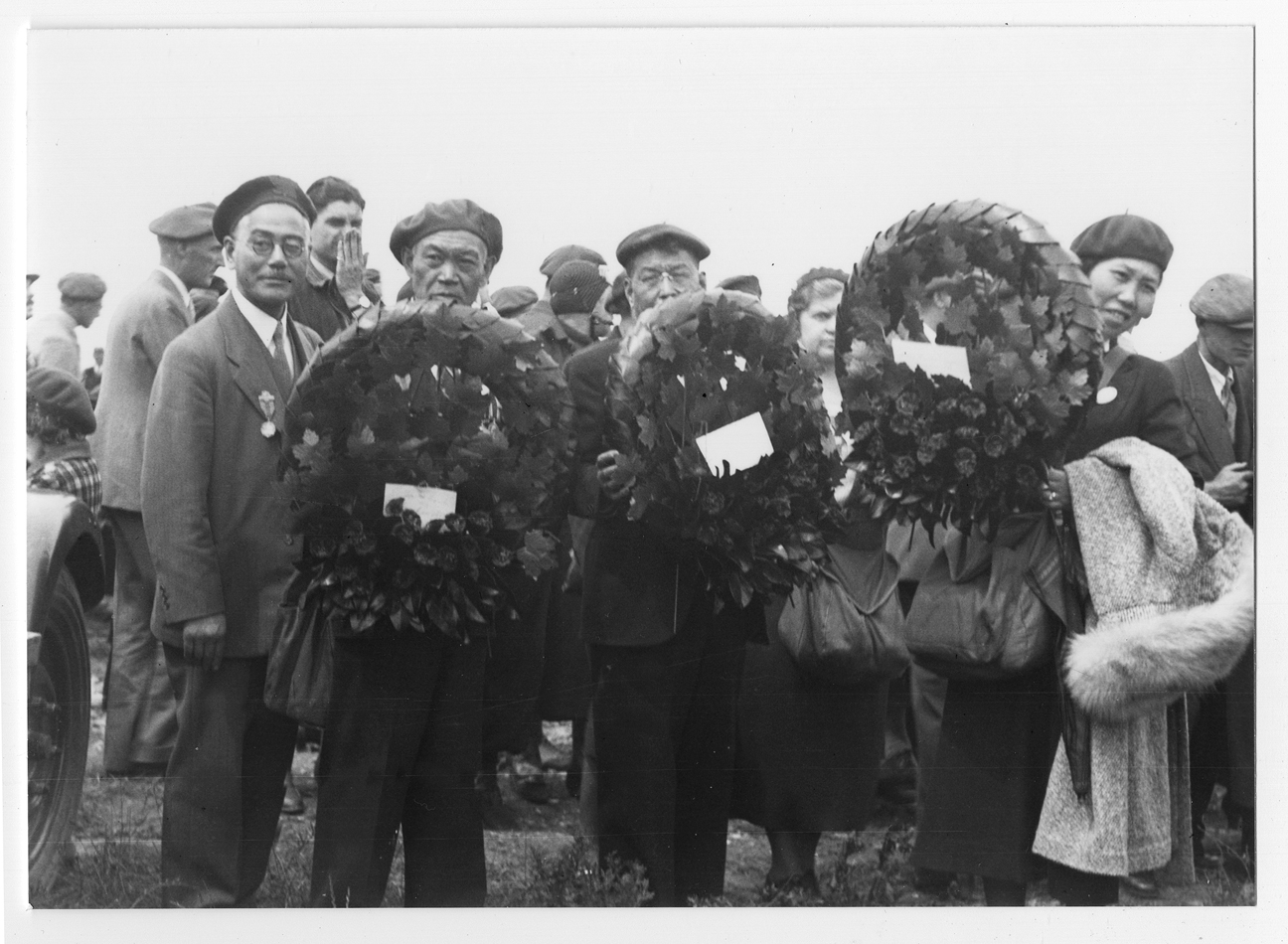
As his logging enterprises expanded, Kagetsu became increasingly involved in the wider Japanese Canadian community in British Columbia. From 1926 to 1930, he served as president of the Canadian Japanese Association.
During his presidency, the Association worked to improve opportunities for Canadians of Japanese descent and to challenge discrimination. It published information about the community, organized events, supported community initiatives, and gathered detailed information about education, employment, income and population.
These surveys documented both the community’s achievements and the discrimination its members faced. Today, they are valuable sources for understanding the lives and circumstances of Canadians of Japanese descent in British Columbia during this period.
As both a businessman and community leader, Kagetsu advocated for greater employment opportunities and fuller participation in the economic and civic life of the province.
War and the Loss of His Workforce
After Canada entered the Second World War against Japan, increasing restrictions made it progressively more difficult for Kagetsu to operate his businesses.
By early 1942, his access to essential supplies, including fuel and dynamite, had been restricted. Then his workforce was taken away.
The RCMP removed 27 working-age men from Kagetsu’s operations. Further research is needed to establish precisely where these men were sent and under what authority.
Kagetsu hired replacement workers, but the solution was temporary. In March 1942, the federal government ordered people of Japanese descent to leave the restricted coastal zone.
Faced with approximately 2.5 million board feet of already-felled timber that would deteriorate if left in the forest, Kagetsu appealed directly to Austin C. Taylor, chair of the British Columbia Security Commission.
He requested permission to employ 23 Nisei or naturalized Canadian workers for two months so that the timber could be removed:
“Should these logs not be removed before this summer, damage from insect attack will make the products almost valueless.”
Kagetsu offered to take responsibility for the workers and stated that they would comply with whatever orders followed once the work was completed.
No formal response was received. According to the family account, Kagetsu later learned through a contact that his request had been denied.
Dispossession
In April 1942, the forced removal of people of Japanese descent from the restricted coastal area proceeded.
Families were initially told that their homes, businesses, and property would be protected by the government for the duration of the war.
Kagetsu carefully documented the extensive business and personal assets placed under government control. They included:
- more than 7,000 acres of timber holdings
- 9.5 miles of railway
- a locomotive
- 19 flatcars
- four engines
- two tractors
- 24 camp buildings
- tools and logging equipment
- houses, land, automobiles, and other personal property
Government policy subsequently changed. Rather than simply holding the property, officials began selling the homes, businesses, land, and possessions of Canadians of Japanese descent, often at prices well below their assessed or market value.
Kagetsu lost a business enterprise that had taken decades to build.
Minto
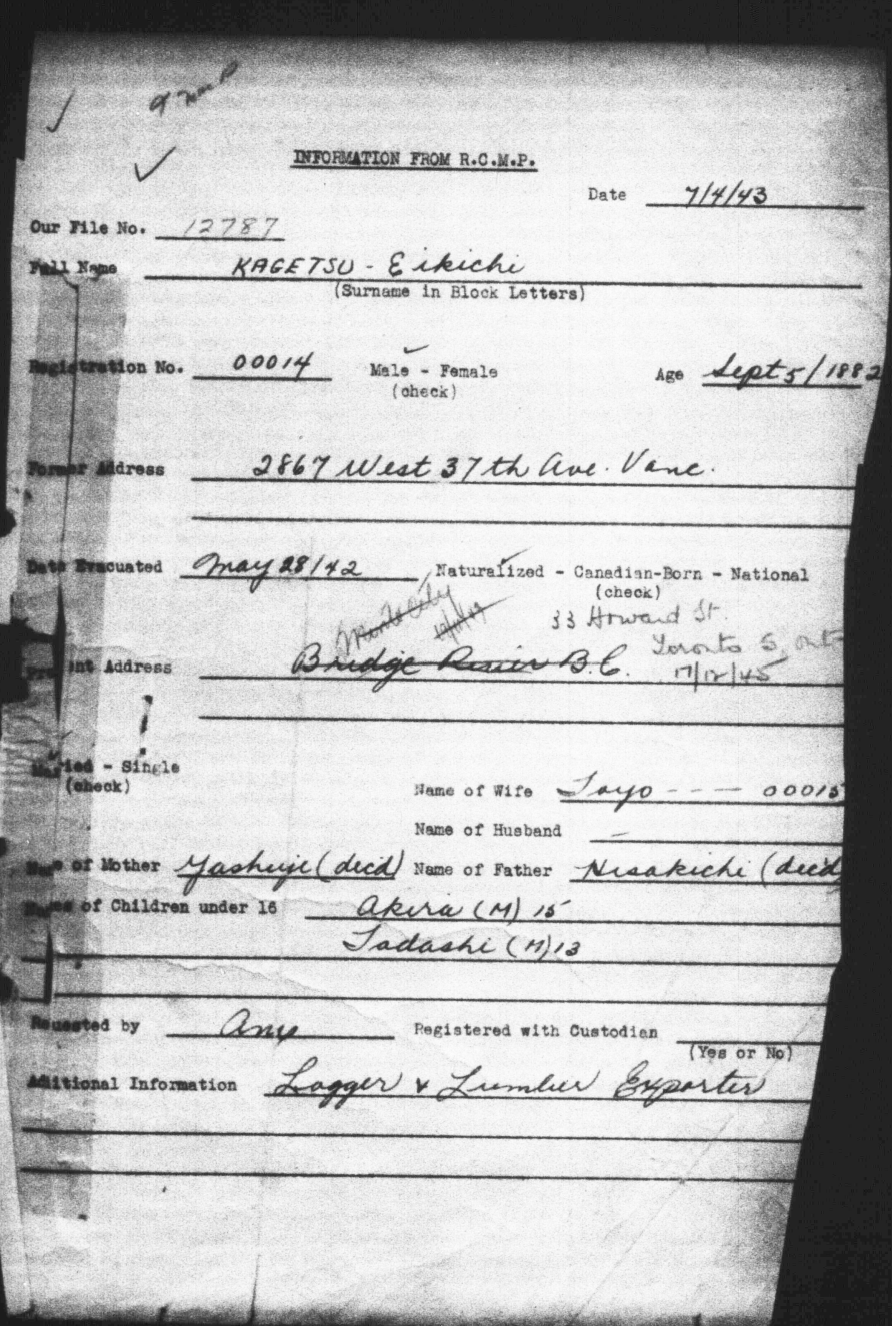
On May 28, 1942, Kagetsu and his family were sent to Minto, one of the self-supporting sites established for Canadians of Japanese descent who had been forcibly removed from the restricted coastal area.
These self-supporting sites were intended for families who could afford to pay many of the costs associated with their own forced removal and confinement. Residents remained subject to government restrictions and were prohibited from returning to their homes on the coast.
Kagetsu paid to make the family's assigned house more habitable. Improvements included a functional kitchen with cold running water, a Japanese-style bath, and a small garden.
Despite these improvements, the family faced significant limitations. Educational opportunities for the children were inadequate, and access to medical care was limited.
Seeking Compensation
After the war, Kagetsu joined his family in Toronto. Beginning in 1947, he and his lawyers documented the extent of his losses, including business assets, investments and personal property that had been sold by the government.
Kagetsu brought his claim before the Royal Commission on Japanese Claims, commonly known as the Bird Commission, which examined claims arising from the government’s handling and sale of property belonging to Canadians of Japanese descent.
Kagetsu calculated his losses at $328,116 — approximately $4.6 million in 2026 dollars based on the Consumer Price Index.
In presenting his case, he described himself as a proud and loyal Canadian.
On March 30, 1950, the Commission awarded Kagetsu approximately $51,000, less than one-sixth of the amount he claimed.
Kagetsu did not consider the award adequate. He and his lawyers continued to press the federal government to reconsider the decision, but the government declined to reopen his case. Correspondence concerning his efforts to have the award reconsidered continued for several years.
Ultimately, Kagetsu was unable to recover most of the wealth and property he had spent decades building.
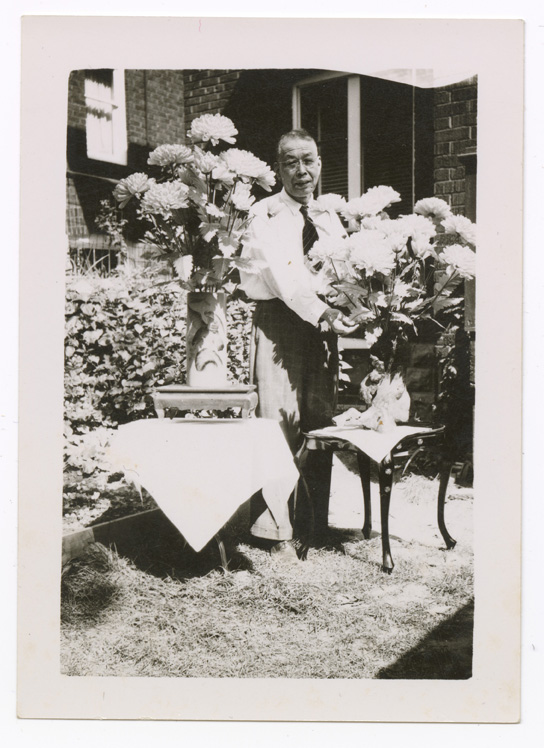
What Kagetsu's Story Reveals
Eikichi Kagetsu suffered losses on an exceptional financial scale, but his experience was part of a much broader government policy that stripped thousands of Canadians of Japanese descent of their homes, property and businesses.
Families lost homes, farms, fishing boats, businesses, vehicles, personal possessions and property accumulated over decades. The forced sale of these assets made rebuilding their lives extraordinarily difficult and created another barrier to returning to the West Coast, even after restrictions were finally lifted in 1949.
Kagetsu’s story brings together many of the themes explored throughout this exhibition: immigration and opportunity, racial discrimination, labour and enterprise, community leadership, forced removal, dispossession and the long struggle for justice.
His experience also shows that the losses cannot be measured in dollars alone. People lost businesses and homes built over lifetimes, communities established over generations, and the freedom to choose where and how they would live.