Manzo Nagano Arrives in Canada
Manzo Nagano arrived in BC in 1877 and is recognized as the first Japanese person known to settle permanently in Canada, beginning Japanese settlement in British Columbia. Over the following decades, immigrants from Japan established lives and communities throughout the province, including in fishing, logging, mining and other industries.
Photo: Manzo Nagano family; City of Victoria Archives, PR-0043-M07756
Learn more >
Japan Opens the Way for Emigration
In 1884, the Japanese government began allowing people from the labouring classes to emigrate abroad. Economic hardship and rapid social change in Meiji-era Japan encouraged some people to look overseas for work and opportunity. In the decades that followed, increasing numbers travelled to British Columbia, where many initially found work in fishing, logging, mining and other industries.
Learn more >
A Regular Route Across the Pacific
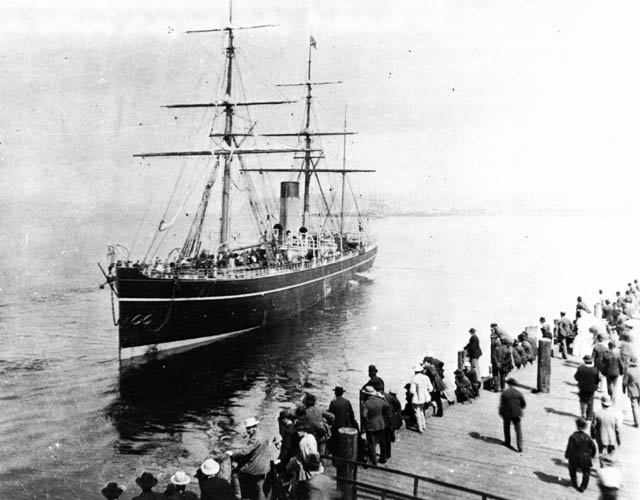
In 1887, regular steamship service began between Yokohama and Vancouver, making travel between Japan and British Columbia more accessible. The new connection contributed to increasing migration from Japan. Many early immigrants came seeking work and economic opportunities in British Columbia’s growing industries.
Photo: SS Abyssinia arriving at Vancouver, June 14, 1887
Learn more
Japanese Lose Voting Rights
In 1895, British Columbia amended the Provincial Voters’ Act to exclude Japanese residents from the provincial voters’ register, denying them the right to vote in provincial elections. The restriction applied regardless of British subject status and became part of a growing system of legal discrimination against people of Japanese descent in British Columbia.
Source: Provincial Voters’ Act Amendment Act, 1895
Learn more
Japanese Workers at Galbraith
In 1899, Edward Galbraith pre-empted 55 acres at what became Galbraith Bay. His daughter Bessie later recalled that her father “hired some Japanese” who built a bunkhouse and cook shack. The workers remained for a year or two, cutting cedar into shingle bolts that were hauled to shore and loaded onto scows for Vancouver.
Learn more
Japanese Loggers on Bowen
The 1901 Census records thirteen Japanese men living in two logging camps on Bowen Island, providing the earliest surviving names we have identified for Japanese residents on the island. Most were recorded as loggers. Their names appear to have been recorded phonetically by the census enumerator, so the historical spellings require careful interpretation. Source: Census of Canada, 1901
Learn more
Vancouver Anti-Asian Riot
On September 7, 1907, an anti-Asian demonstration in Vancouver developed into violence as a crowd moved through Chinatown and then into the Japanese neighbourhood around Powell Street, damaging businesses and homes. Japanese residents defended their community. The riot reflected the intense anti-Asian racism and exclusion that Japanese immigrants encountered in British Columbia.
Learn more